Robin's Short Version
- Hemorrhoids are swollen veins in or around the rectum, and they affect roughly one in four adults.
- Chronic constipation and straining are major drivers, so improving hydration, movement, fiber, and stool regularity is the first step.
- Topicals and sitz baths may ease itching, pain, and swelling, but they do not address the underlying cause.
- An external exam and anoscopy can identify what you have; a colonoscopy may provide a fuller picture, especially after age 45.
- If conservative care is not enough, rubber band ligation or hemorrhoidectomy may be appropriate depending on severity.
One in four adults has them — and almost nobody talks about it until a colonoscopy finds them by accident.
All three of my kids were big. My last, my son, I had at 40 — and I gained more than 50 lbs with every single pregnancy.
My internal hemorrhoids showed up after that first pregnancy and never fully left. They got better. They didn't ruin my life. But they were always there — and the last couple of years, off and on, they've gotten worse.
So I finally did what I tell my patients to do and had it looked at.
I'll get to what that exam actually involves in a minute. But first: hemorrhoids are not a niche problem, and they are not just a “getting older” problem, and they are almost always trying to tell you something else is going on.
Let's talk about it.
⚡ Forward this protocol
Treat the constipation, not just the hemorrhoid
Most hemorrhoids are downstream of one thing: chronic constipation. Fix that, and you fix most of the problem.
The 2-part protocol:
- Treat the constipation, not just the hemorrhoid — water, fiber, magnesium oxide, and a good probiotic, daily.
- Get it checked, don't just live with it — an exam takes minutes and tells you exactly what you're dealing with.
What to know: hemorrhoids are common, and constipation is usually the reason.
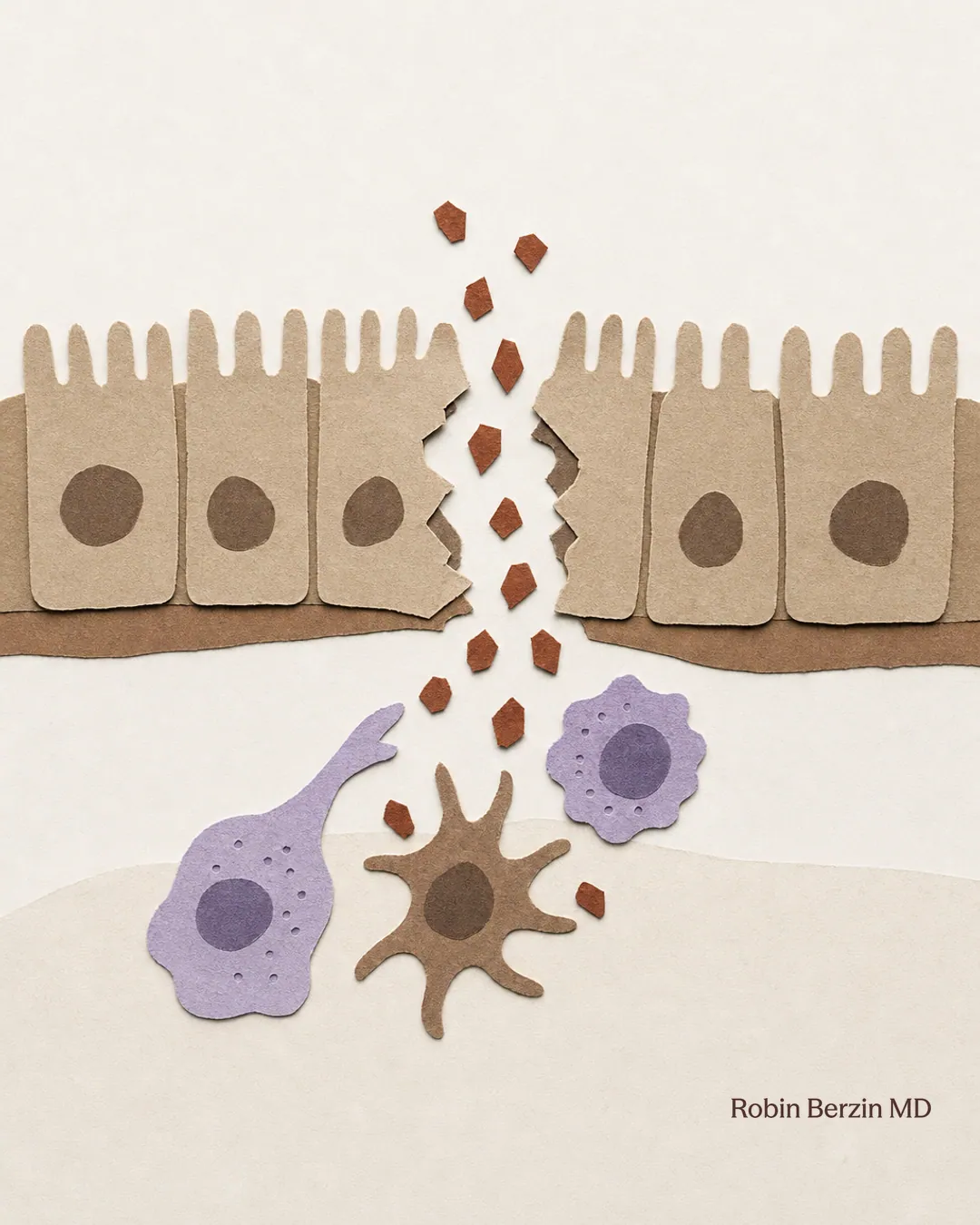
Hemorrhoids are just swollen, engorged veins in and around the rectum — internal (inside, often painless until they bleed or prolapse) or external (outside, where they can itch, hurt, and clot). A global analysis of over 8.6 million people found they affect roughly 1 in 4 adults — 27.3% of women and 25.7% of men.1 Women edge out men mostly because of pregnancy — the added abdominal pressure and vascular changes push veins to swell.
The real driver, for most people, is straining — and straining almost always means constipation. Chronic constipation affects an estimated 15% of the U.S. population.2 Every time you strain against hard, infrequent stool, you're putting direct pressure on those veins. Fix the constipation and, for most people, the hemorrhoids calm down too.
Here's the part that gets me: most people don't find out they have internal hemorrhoids until their first colonoscopy in their mid-40s — because internal ones often don't hurt, and because this is one of those topics we're all a little too embarrassed to bring up, even with our own doctors. That embarrassment is exactly why it gets ignored, and ignoring it is exactly what lets it get worse.
What to do: the actual protocol
Step 1: Fix the constipation. This is the whole game.
- Water: 9–13 cups (2.2–3L) a day. More if you're active or it's hot out.
- Move daily: a 20-minute walk measurably speeds up gut motility, almost immediately.3 Aim for 30 minutes most days.
- Fiber: 25g/day if you're a woman under 50, 21g if you're 51+ (most of us are only getting ~15g).4
- Psyllium husk: 1 tsp–1 tbsp in water, once a day to start.
- Ground flaxseed: 1–2 tablespoons daily — stir into oatmeal, yogurt, or a smoothie.
- Magnesium oxide: ask your doctor. Study dose was 500mg, 3x/day, and it more than doubled response rates for chronic constipation (70.6% vs. 25% placebo).5
- A solid daily probiotic — low Bifidobacterium and Lactobacillus are consistently linked to constipation.6 I like Seed's DS-01 Daily Synbiotic or Parsley's Probiotic. For a deeper look at the gut ecosystem, read Robin's guide to butyrate and gut health.
- MediNatura BHI Hemorrhoid Relief — a homeopathic remedy (comes bundled with their Constipation Relief tablets). I can't explain the mechanism, but it's worked for me and for patients. Worth a try once the basics are in place.
Step 2: Ease the symptoms — but know this isn't treating anything.
- Itching → witch hazel pads.
- Pain → lidocaine cream or wipes (numbs in 30–60 min).
- Swelling/inflammation → hydrocortisone cream, short-term only (max 1 week).
- Sitz bath = a shallow warm-water soak for your bottom, in the tub or a basin that fits over your toilet. Fill with a few inches of warm water, add 1–2 cups of Epsom salt (magnesium sulfate), soak 15–20 minutes, 1–3x a day — especially after a bowel movement.
- Reality check: a review of the evidence found no strong proof sitz baths or topicals actually speed healing.7 They calm things down. They don't fix the hemorrhoid.
Step 3: Get evaluated — you need to know what you actually have.
- External exam + anoscopy (a small scope, done by a GI doctor, to check internally).
- Colonoscopy for the fullest picture, especially at 45+.
- This is what tells you which of the three real treatment paths applies to you: conservative care (step 1 and 2), banding, or hemorrhoidectomy.
Step 4: If conservative care isn't enough, know your options.
- Banding (rubber band ligation): minimally invasive, in-office, often done by a GI or colorectal doctor.
- Hemorrhoidectomy: surgical removal for larger or more advanced internal hemorrhoids — colorectal surgeon only.
- Insurance: both are typically covered when medically necessary (not elective/cosmetic) — banding usually runs $75–$211 out-of-pocket, hemorrhoidectomy $364–$630, under Medicare rates;8 private insurance varies, so confirm your specific plan and any prior-authorization requirements.
The goal: most people never need step 4. Fix the constipation, and you fix most of the problem.
The Momgevity Files
I recently saw a gastroenterologist to finally get my hemorrhoids properly evaluated. It's a two-part exam: first an external look, then an anoscopy — a small scope that lets the doctor see directly inside the rectum.
The good news: no external hemorrhoids. The less good news: internal ones, confirmed. He told me the most complete way to see them is through a colonoscopy — which I have coming up.
I'm not sharing this because it's dramatic. I'm sharing it because it's ordinary, and it's exactly the kind of ordinary thing we don't say out loud. If I hadn't finally gone in and asked, I'd still just be living with it — the same way I suspect a lot of you are living with something similar right now.
When it comes to our health, especially as women, especially as parents, how much are we just living with, brushing aside, ignoring or pretending isn’t there? Constipation, bloating, fatigue, hair loss, headaches, aches and pains… our healthcare system has made it hard to get these kinds of things addressed so we just, don’t.
But your body is the most sophisticated technology known to man. More than LLMs, more than chatbots, more than space travel. There is much we still don’t understand about how our cells work. And if we revere our bodies, love them, listen to them, green them with warm eyes and curiosity, they have so much intelligence for us.
If there is something about your health you’re ignoring, consider it the first step in your longevity journey to get curious, keep a journal on it, ask yourself questions about what makes it worse or better and get it looked at. Most of the time there is something we can do about it - especially in functional medicine! And when we take care of our health, we unlock our lives.
Originally published in the Off Script newsletter. Join Robin’s readers for weekly functional medicine insights.
As always, this newsletter is for informational and educational purposes only and is not intended as medical advice. Always consult your healthcare provider before making any health decisions or changes to your treatment plan.